




How Are Backpacks Made? A Manufacturing Process Guide for Brands
If you are building a bag line, the question how are backpacks made is not a trivia question. It is a practical shortcut to better decisions. Brands that understand the backpack manufacturing process tend to waste less time on avoidable revisions, catch quality risks earlier, and plan timelines that match how factories actually work. This guide breaks down the backpack production process step by step, with a brand-focused lens: what happens at each stage, what can go wrong, and what you should confirm if you want repeatable results.
Step 1: Product Definition and Use-Case Planning
Every solid backpack manufacturing project starts with a clear definition of how the product will be used. “Women’s lifestyle backpack” and “work commuter backpack” can look similar in photos, but they behave differently when loaded, worn, and used daily. Before patterns or materials are discussed, align on:
-
Capacity and typical carry items
-
Target weight and load distribution
-
Entry type (zip, flap, drawstring) and access priorities
-
Key comfort points (strap width, padding, back panel feel)
This is more than design taste. It is backpack design planning that determines structure and cost. If you skip this stage, the mistakes usually show up later as uncomfortable straps, unstable shape, or pockets that do not fit real items. A good backpack manufacturer will ask these questions early because they affect everything downstream.
Step 2: Material Selection and Supply Chain Coordination
Backpack material selection is where many brands unintentionally lock in future problems. The main fabric choice affects shape retention, abrasion resistance, perceived quality, and color behavior. The same style can feel premium or cheap depending on fabric hand feel and finishing.
Key material categories typically include:
-
Main fabric (canvas, nylon, blends)
-
Lining fabric (often overlooked, but impacts perceived value)
-
Webbing (strap feel and durability)
-
Padding and reinforcement (structure and comfort)
-
Hardware (zippers, buckles, sliders, D-rings)
This step is also where the backpack supply chain starts to matter. If a factory relies on inconsistent upstream suppliers, your reorders can drift in color, texture, or hardware finish. For core SKUs and repeat orders, ask how the backpack factory sources and controls fabric lots, hardware suppliers, and webbing color matching. Even if your first shipment looks good, unstable sourcing can turn replenishment into a constant firefight.
Step 3: Pattern Making and Technical Setup
If you want to know where quality is truly “built,” the answer is backpack pattern making. Patterns translate your concept into measurable panels, seam allowances, and assembly logic. This is where fit, balance, and structure are determined.
In practical terms, patterns control:
-
Proportions and silhouette
-
Pocket volume and placement accuracy
-
Strap angle and carry comfort
-
Reinforcement placement for load-bearing areas
For brand projects, this is also where the workflow differs across ODM backpack manufacturing and OEM backpack manufacturing. In an ODM path, you may start from a proven base pattern and adjust specific elements. In an OEM path, you often provide detailed specs and expect strict execution. Either way, the technical setup must be documented clearly. If pattern logic lives only in someone’s memory, you risk drift between samples, production lines, or future reorders.
Step 4: Sampling and Pre-Production Validation
Sampling is not a single step. It is a controlled sequence that prevents expensive surprises in bulk. Backpack sample development typically moves through stages such as:
-
Initial prototype for structure and proportions
-
Revised sample for functional refinements
-
Pre-production validation sample that mirrors factory production steps
The biggest misunderstanding brands have is assuming that “a good sample” guarantees a good shipment. A sample can be hand-tuned by a skilled technician. Bulk production must be repeatable across many operators and days. That is why pre-production validation is critical, especially for custom backpack manufacturing process projects with unique trims, special pockets, or brand-specific details.
What to confirm during sampling:
-
Measurement tolerances (what range is acceptable in production)
-
Stitching specs at load-bearing points
-
Zipper smoothness and hardware consistency
-
How branding is applied (patch, embroidery, printing) and how it holds up
If you want fewer disputes later, lock these points before cutting bulk fabric.
Step 5: Fabric Cutting and Process Preparation
Once a style is validated, production starts with fabric cutting for backpacks. Cutting accuracy is a major driver of consistency. If panels drift, you see it later as uneven seams, pocket misalignment, or a bag that looks “off” even if you cannot immediately explain why.
Cutting includes:
-
Fabric inspection and spreading
-
Panel cutting (manual or automated)
-
Marking and bundling panels by size and color
-
Preparing reinforcements and interlinings
At this stage, brands should pay attention to lot management. If your order requires multiple fabric lots, the factory should plan cutting to reduce visible shade differences within the same shipment. This is particularly important for mid-tones and neutrals, where small variations can read as a different color under store lighting or in product photos.
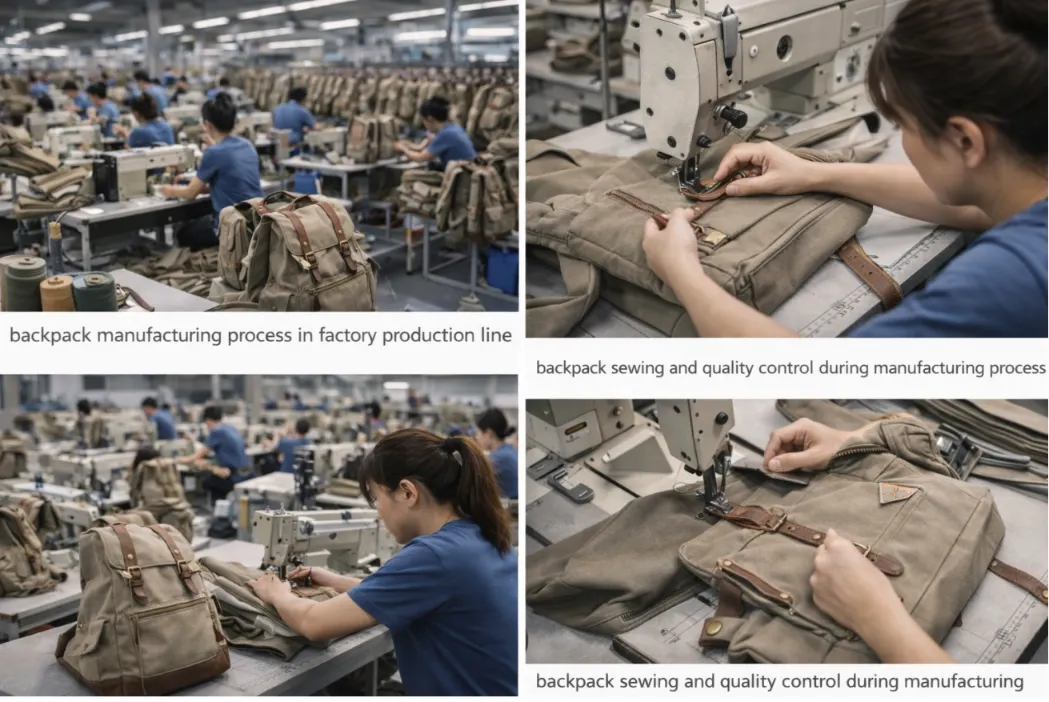
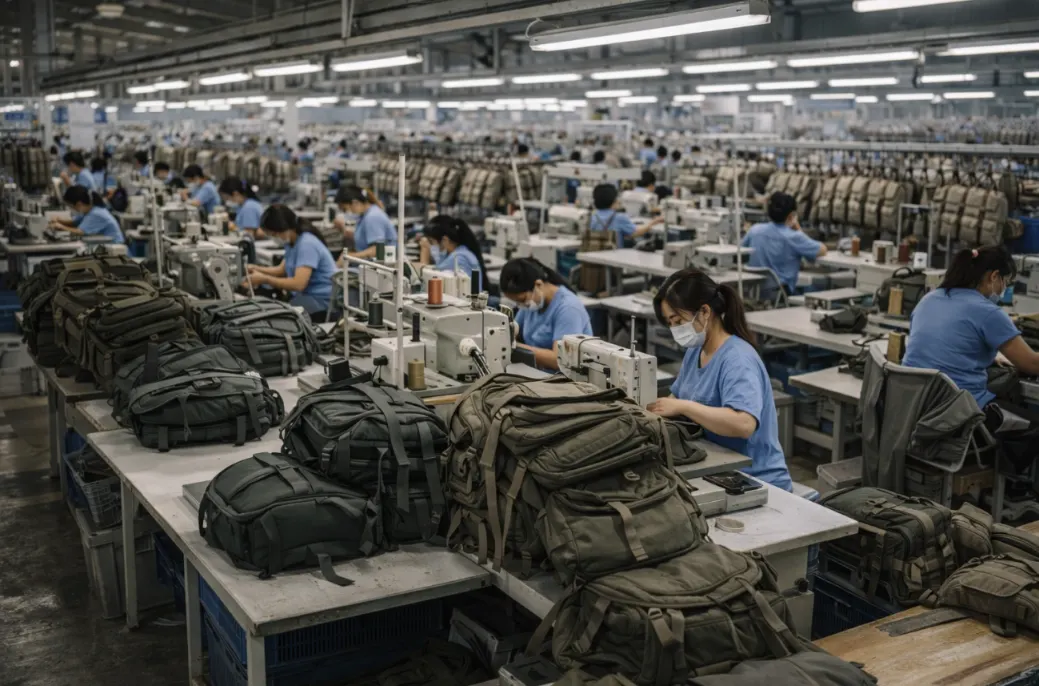
Step 6: Sewing, Assembly, and Load-Bearing Reinforcement
This is the stage most people imagine when they think about how a backpack is manufactured, but for brands it is not just “stitching.” It is the point where durability and comfort are either locked in or compromised.
Backpack sewing and assembly typically involves:
-
Building major panels (front, back, sides, base)
-
Installing pockets and internal compartments
-
Attaching shoulder straps and top handles
-
Adding back panel padding and lining
-
Closing seams and shaping the bag
Backpacks are more demanding than many handbags because they carry weight and face repeated stress at specific points. A production-ready bag must handle:
-
Strap anchor load
-
Bottom seam stress
-
Zipper seam stress during daily opening and closing
Reinforcement methods vary by product positioning and cost target, but brands should ensure the factory treats load-bearing areas as non-negotiable. If you plan bulk backpack manufacturing, the factory’s consistency at strap anchors and base seams often determines return rates more than any other factor.
Step 7: Hardware Installation and Detail Control
Hardware and finishing are where perceived quality rises or collapses. Backpack hardware installation includes zippers, sliders, buckles, snap closures, metal rings, and custom pulls. It also includes detail elements like binding, edge finishing, and branding application.
Common brand-level risks here include:
-
Hardware color mismatch between suppliers
-
Zippers that feel rough in bulk despite smooth samples
-
Logo placement drift when production speeds up
If you are building a private label backpack manufacturing program, details must remain stable over time. Ask how the factory controls hardware sourcing, incoming inspection, and in-line checks for detail placement. It is also worth confirming what the factory does when hardware supply changes due to vendor issues. The best backpack factory will propose substitutions only with your approval and with a clear quality justification.
Step 8: Quality Control Across Production Stages
“QC at the end” is not enough. Strong factories run backpack quality control at multiple points, because catching issues early is cheaper and prevents bulk waste.
A practical QC structure often includes:
-
Incoming material checks (fabric defects, hardware function)
-
In-line inspection during sewing and assembly
-
Final inspection for measurements, appearance, and function
Typical checks for backpack projects:
-
Strap strength and attachment security
-
Seam uniformity and stitch density
-
Zipper performance and alignment
-
Pocket symmetry and usability
-
Overall shape consistency and clean finishing
For brands, the most important part is alignment on standards. Define what counts as a critical defect, major defect, and minor defect. If you never align on this, you will argue at shipment time instead of preventing the issues in the first place.
Step 9: Packaging, Logistics, and Shipment Readiness
The backpack packaging and shipment stage often decides whether goods arrive in saleable condition. Packaging is not just a cost item. It is a quality protection tool.
Packaging considerations include:
-
Dust bags or protective polybags
-
Shape protection to reduce crushing in cartons
-
Carton strength and packing method
-
Labeling, barcodes, and shipping marks
Brands should also confirm shipment readiness checks:
-
Carton drop resistance for long-distance transpor
-
Moisture protection if shipping conditions are variable
-
Photo confirmation standards before container loading
If you are running a replenishment program, consistent packaging makes warehouse handling easier and reduces claims due to transit damage.
Conclusion: Manufacturing Knowledge Is a Brand Advantage
So, how are backpacks made in a way that supports brand growth? They are made through a system, not a single step. When you understand the backpack manufacturing process, you can plan specs that survive scale, select materials that reorder reliably, and build a production workflow that avoids repeat mistakes. For brands, manufacturing knowledge is not about becoming a factory. It is about controlling outcomes: consistency, durability, lead time, and the ability to grow from one style into a stable product line.
Chic’s Practical Approach to Scalable Backpack Manufacturing
Chic supports brand-focused projects by treating manufacturing as a repeatable process rather than a one-time shipment. That means aligning product definition early, controlling materials through stable sourcing, validating samples with production-level discipline, and maintaining quality standards that carry into repeat orders. This approach helps brands reduce variation across bulk production runs and build backpack programs that remain consistent as SKUs expand and replenishment cycles accelerate.
FAQ
Q1: Which step in the backpack production process causes the most delays for brands?
A: Sampling and pre-production validation often cause the most delays, usually because specs are not fully aligned or changes keep expanding. Clear documentation early reduces revision cycles.
Q2: What should brands lock first in a custom backpack manufacturing process?
A: Lock the core structure, key measurements, and load-bearing reinforcement method first. Cosmetic details are easier to adjust than structural elements once production is planned.
Q3: How can you improve backpack quality control without increasing costs too much?
A: Add simple in-line checks for strap anchors, zipper alignment, and pocket symmetry. Catching defects early reduces rework and prevents bulk scrap, which often saves money overall.
Q4: Why do samples sometimes look better than bulk production?
A: Samples can be hand-tuned by experienced technicians. Bulk production relies on repeatable steps across many operators, so documentation, jigs, and process control matter more than craftsmanship alone.
Q5: How do you choose between ODM backpack manufacturing and OEM backpack manufacturing?
A: ODM can speed up development when you start from a proven base pattern, while OEM is stronger for strict control once your specs are fully defined. Many brands use a hybrid path: ODM for launch, then OEM discipline for reorders.

 consult
 WHATSAPP
 leave message
 top
top