



Best Features to Look for in a Travel-Ready Nylon Crossbody Bag
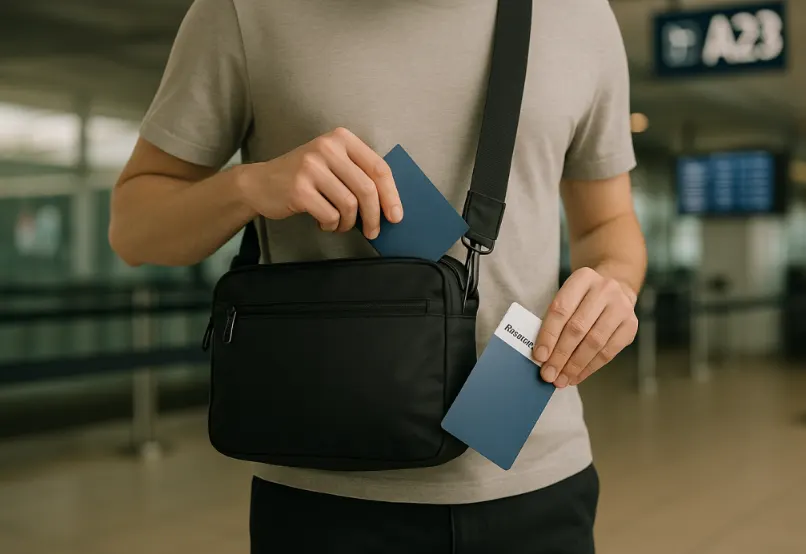
If you’ve ever tried to fish a passport out while juggling a latte, a trolley, and a boarding pass, you know the wrong bag turns travel into a circus. A travel-ready nylon crossbody bag does the opposite: it keeps your hands free, your essentials sorted, and your mind calm when the line starts moving. This guide walks you through the features that actually matter—so you don’t overpay for gimmicks or end up with a pretty bag that underperforms on the road.
Why a Nylon Crossbody Bag Works So Well on Trips
Nylon earns its spot in travel because it’s light, tough for the weight, and easy to wipe clean after a rainy cab dash or a coffee splash. The crossbody carry adds security and comfort: the bag sits close to your torso, stays in sight, and doesn’t slide off your shoulder every time you bend to scan a QR code. For city walks, airport runs, and half-day excursions, this combo is hard to beat.
How to Choose a Nylon Crossbody Bag for Vacation (Without Overthinking It)
Start with your itinerary and daily loadout. Weekend city break? You want compact and quick-access. Two-week multi-city itinerary? You’ll want slightly more capacity plus better organization. The trick is simple: size to the items you actually carry, not the items you might carry “just in case.” That one mindset keeps bags lighter, cleaner, and way easier to live with.
A quick capacity reality check
-
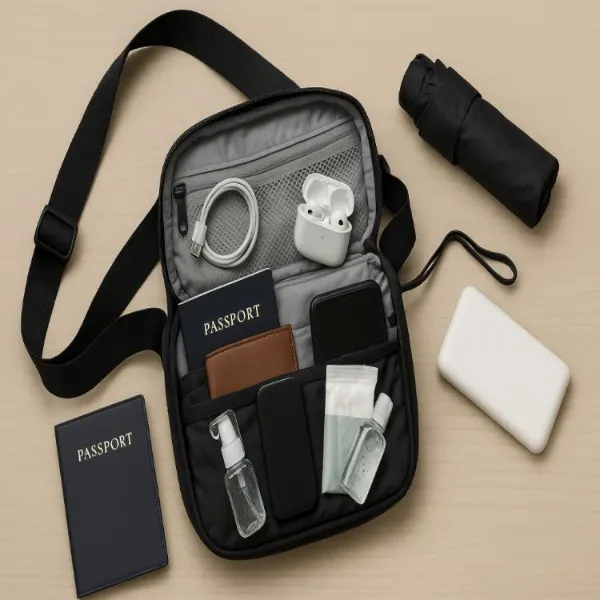
Everyday city carry: phone, slim wallet, passport, keys, tissues, earbuds, small sanitizer, charging cable, power bank
-
Rainy day add-on: packable mini umbrella (place it vertically against the back panel), zip pouch for wet mask/tissues
-
Museum or stadium rules: some venues cap bag width/volume; compact crossbody sizes help you breeze through
The Feature Checklist That Matters (And What Each One Does for You)
Use the table below as a practical spec sheet when comparing a travel-ready nylon crossbody bag. If a product page doesn’t state these basics, that’s a sign to keep scrolling.
| Feature | Why it matters on trips | Minimum you should look for |
|---|---|---|
| Weight | Less fatigue during all-day wear | ~400 g or under (empty) |
| Fabric | Abrasion resistance + quick wipe-down | Mid-to-high denier nylon with PU or DWR finish |
| Water protection | Keeps boarding docs/phone dry in light rain | Water-resistant shell; covered zippers or rain flaps |
| Compartments | Faster access, fewer “bag dives” | 3–5 zones: quick-access front, secure main, hidden back pocket |
| RFID pocket | Peace of mind in crowded transit hubs | Shielded sleeve sized for passport/cards |
| Strap & pad | Comfort + stability; prevents digging | 1.2–1.5 in (3–4 cm) width; soft pad; anti-slip backing |
| Hardware | Reliability under stress | Smooth coil zippers; metal pulls; reinforced D-rings |
| Size envelope | Personal-item friendly | Roughly 9–12 in (23–30 cm) wide; low-profile depth |
(Side note: if you always end up stuffing a water bottle inside, consider an external stretch pocket or side leash. It saves the liner from condensation and keeps the main compartment clean.)
Waterproof vs. Water-Resistant: What You Actually Need
Most nylon crossbody bag shells are water-resistant, not fully “waterproof.” For travel, that’s usually enough—light rain beads off, and your papers stay dry as you move between stations, taxis, and terminals. If your plans include heavy rain or boat rides, look for taped seams and zipper garages. A quick daily habit helps too: wipe the shell with a clean cloth after rain so the DWR coating keeps doing its job.
Cleaning in real life (no drama)
-
Spot clean with mild soap and a damp cloth
-
Avoid hot water and harsh bleach
-
Air-dry out of direct sunlight
-
Empty the bag at night; crumbs, sand, and ticket stubs collect faster than you think
Smart Organization That Speeds You Up
Good layouts feel obvious. Your passport sits in a high, tight pocket that your hand finds without looking. Your phone slot faces you—screen up, face ID ready. Charging cable and earbuds live in a mesh zip so they don’t knot around keys. When you reach security, liquids are together in a transparent pouch that lifts in one move. Small choices, big difference.
A simple, high-signal layout
-
Front quick-access: transit card, tissues, receipts
-
Main compartment: passport sleeve, phone sleeve, mesh zip (cables), and a small pouch (meds/lip balm)
-
Hidden back pocket: cash, spare card, backup key
-
External point: clip or strap for umbrella or bottle (if you always carry one)
Security Features That Actually Deter Pickpockets
Crowded metros and touristy streets invite quick hands. A better bag won’t make you invincible, but it tilts the odds in your favor.
-
Hidden or lockable zippers slow casual grabs
-
RFID-blocking lining protects cards/passports from skimming in busy stations
-
Body-facing pocket for your passport and primary payment card
-
Cut-resistant webbing is a plus if you frequent high-risk areas
Strap Comfort: Small Detail, All-Day Impact
The strap is the part you “feel,” hour after hour. Look for a width around 3–4 cm with a soft pad that won’t migrate. More adjustment holes or a long slider range help find the sweet spot, typically where the bag sits just above your hip bone. Switch shoulders if you’re walking long distances—your neck will thank you.
Materials That Match Your Itinerary
Nylon isn’t one fabric; it’s a family. Higher denier counts tend to be tougher but can feel stiffer. Recycled nylon options are now common and fit travel use well.
-
Standard nylon: light, quick-dry, reliable for city and light outdoor use
-
Recycled nylon: similar feel and strength with a smaller footprint
-
Lined interiors: light-colored liners make it easier to find black cables and dark cards
Two Loadouts That Cover Most Trips
Compact city day (hands-free)
-
Phone, slim wallet, passport, keys
-
Cable + buds in a mesh zip
-
Travel tissues, sanitizer
-
Mini umbrella (vertical, against the back panel)
Transit day (airport or train)
-
Everything above
-
Boarding docs in a tall sleeve
-
Clear 100-ml liquids pouch
-
Power bank + short USB-C cable
-
Spare mask/eye drops (tiny pouch)
When a Second Crossbody Makes Sense
If evenings matter on your trip—dinners, shows, rooftop stops—consider a smaller “night” crossbody and a slightly larger day bag. Swapping instead of repacking prevents the classic passport-left-on-the-hotel-desk moment.
About Chic (Yiwu Chic Trading Co., Ltd.)
Chic focuses on bags and bag accessories with categories that include Crossbody Bag, alongside cosmetic bags, totes, wallets, chains, straps, and more. The site also highlights customization and service pages, reflecting a capable setup for made-to-order details and private-label work. Contact options—phone, email, and a Yiwu address—are published openly, which makes project communication straightforward for overseas buyers.
Conclusion
A travel-ready nylon crossbody bag should feel invisible until the moment you need it. Keep the checklist tight: light weight, a water-resistant shell, 3–5 smart compartments, a real RFID pocket, smooth hardware, and a strap you forget about after ten minutes. Size it to how you move, not how you imagine you might move, and you’ll travel faster, think less, and enjoy more of the reason you flew in the first place.
FAQs
Q1. What size actually works for flights with a travel-ready nylon crossbody bag?
Think slim first. A nylon crossbody bag that’s roughly 9–12 inches wide and 2–4 inches deep slides under most seats without fuss. Keep the profile flat so it sits on your lap at boarding and doesn’t fight the tray during security checks. If you carry a paperback and a mini umbrella, aim for the taller, narrow shapes—they ride better against your torso.
Q2. How to choose a nylon crossbody bag for vacation days with lots of walking?
Start with weight. Under ~400 g keeps shoulders happy after a few miles. Then check the strap: 3–4 cm wide with a soft pad and enough adjustment so the bag lands near your hip bone. Pack heavy stuff (power bank, coin pouch) against the back panel so the bag doesn’t bounce. Sounds tiny, but after 5 km you’ll feel the difference.
Q3. Are travel-ready nylon crossbody bags waterproof or just rain-friendly?
Most are water-resistant, which is perfect for drizzle and quick dashes. For serious rain, look for taped seams and zipper covers (little “garages” at the ends). Quick routine: shake off drops, pat dry with a towel, and leave pockets open for ten minutes in your room. No drama, and your passport stays crisp.
Q4. What makes a nylon crossbody bag feel safer in crowded subways and tourist spots?
Three simple wins: a body-facing pocket for the passport, hidden or lockable zippers on the main compartment, and an RFID sleeve for cards. In busy stations, swing the bag to the front and clip the zipper pulls together with a tiny carabiner. Some travelers even carry a decoy card sleeve in the front pocket—cheap trick, works fine.
Q5. How do you clean a nylon crossbody bag between flights without wrecking it?
Spot clean with mild soap and a damp cloth. Lint roller for crumbs; gone in ten seconds. Funky smells after a humid day? A pinch of baking soda in an empty pouch overnight, then shake out. Machine wash only if the tag says it’s okay—cold water, laundry bag, hang dry. No heat. Nylon likes shade more than sunlight.

 consult
 WHATSAPP
 leave message
 top
top