


Related news
Cosmetic Bag Sizes: Matching Dimensions to Beauty Product Sets
The right cosmetic bag size is not simply small, medium, or large. For a beauty brand, it is the smallest practical internal space that holds the intended products in the correct orientation, closes without strain, and still presents the assortment well. Start with the exact fill list, estimate the space it occupies, account for the bag’s construction, and then confirm the result with a loaded physical sample. This approach is more reliable than copying a competitor’s external dimensions.
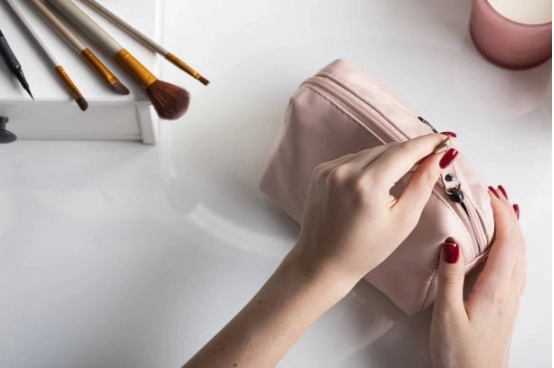
Start with the Beauty Product Assortment
Define what the bag must carry before deciding its shape. A pouch for two samples has a different job from a retail makeup set or a travel kit with upright skincare bottles. The following ranges are starting envelopes for prototyping, not universal size standards.
| Assortment | Suitable Starting Form | Illustrative Internal Envelope |
| Mini or sample set | Flat or lightly gusseted pouch | 16-18 x 10-12 x 4-5 cm |
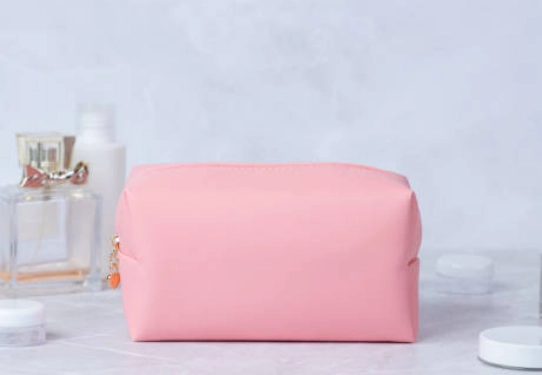
| Daily retail set | Box pouch | 20-23 x 12-15 x 6-9 cm |
| Travel or gift set | Deep gusset or train-case form | 24-28 x 16-19 x 9-13 cm |
Orientation matters as much as volume. A 17 cm brush may force the width, while an upright serum bottle may determine height. The planned level of fullness also affects presentation: a gift set can look underfilled in an oversized bag, while a tightly packed retail set can be frustrating to use. Review Chic’s custom cosmetic bag range for structural references, then size the chosen form around the actual assortment.
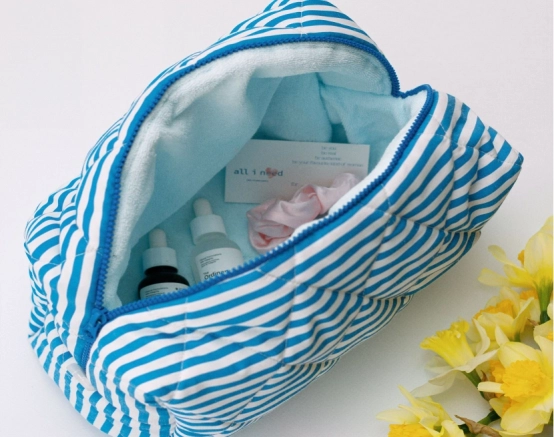
A Capacity Calculation for Early Sizing
A simple volume estimate can reveal whether an initial concept is obviously too small. Treat each product as a rectangular bounding box and calculate:
Product volume = length x width x height
Add the product volumes, then divide by an assumed packing factor:
Required internal volume = total product bounding-box volume / packing factor
The packing factor represents how efficiently the items can occupy the bag. It must be an explicit design assumption, not a claimed standard. Rigid bottles, irregular caps, brush bundles, and protective spacing create empty space.
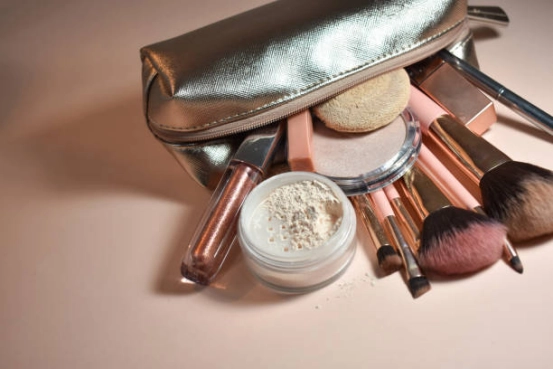
Consider an illustrative set containing a foundation bottle (12 x 4 x 4 cm), compact (8 x 8 x 2 cm), palette (16 x 9 x 1.5 cm), mascara (13 x 2 x 2 cm), two lipsticks (each 8 x 2 x 2 cm), and a brush bundle (18 x 5 x 3 cm). Their bounding-box volumes total 922 cm3. Using 0.65 as an early planning assumption gives:
922 / 0.65 = 1,418 cm3
A trial internal envelope of 22 x 12 x 6 cm provides 1,584 cm3. That result suggests enough theoretical volume, but it does not prove fit. The palette and brushes may conflict in orientation, and the zipper opening may be narrower than the body. A paper mock-up or sewn sample loaded with the real products remains the deciding test.
Shape and Construction Reduce Usable Space
External volume is not usable volume. A flat pouch loses depth near its top corners. A box pouch keeps more of its nominal depth but uses material in the corner seams. A train-case form may provide better access while allocating space to a lid, piping, handles, or dividers.
Material selection changes the geometry too. Thick padding, stiff PU, bound seams, and laminated linings consume more clearance than a light unpadded textile. Pockets and elastic loops organize products but prevent them from shifting into otherwise open spaces. The zipper path also matters: a long top opening can admit a palette that would not pass through a short curved opening, even when the body volume is adequate. Compare custom bag materials before freezing dimensions, because structure and size must be developed together.
Turn Dimensions into a Manufacturable Specification
A useful specification separates the finished external size from the minimum clear internal space. State the measurement order as width x height x depth and show exactly where each dimension begins and ends. For a tapered or curved bag, one number may be insufficient; the drawing may need top and base widths or a section view.
The same document should show the required product orientation, zipper opening, pocket positions, divider thickness, and any item that must remain upright. Place the logo area on that drawing so branding does not cross a seam or disappear around a curve. Packaging also belongs in the size discussion: a bag that fits its contents may still be unsuitable for a planned retail carton or shelf footprint.
Chic’s customization options cover material, color, logo, label, and packaging choices. Pair those choices with a dimensioned drawing and a loaded sample. Agree project-specific measurement tolerances with the manufacturer instead of assuming one tolerance applies to every fabric and construction.
Common Sizing Errors That Raise Cost or Reduce Usability
Sizing around one hero product can overlook brushes, caps, or secondary packs that control the final geometry. Copying external measurements without allowing for seams and padding can produce a bag that looks correct but cannot close comfortably.
Oversizing is not automatically safer. Extra material, larger packaging, and lower perceived fullness can weaken both cost control and presentation. The related analysis of wholesale cosmetic bag cost factors explains why size is only one part of the commercial equation. Finally, do not approve an empty sample by appearance alone. Load it with production-equivalent items and test access, closure, stability, and repacking.
FAQ
These questions resolve the practical details that often remain after an initial size has been calculated.
What Is the Most Common Cosmetic Bag Size?
There is no universal standard size. Many everyday pouches sit in a middle range, but that label does not define their depth, opening, or usable capacity. Specify dimensions against the intended fill rather than ordering a generic medium bag.
Should Cosmetic Bag Dimensions Be Internal or External?
Record both. Minimum clear internal dimensions determine whether the products fit. Finished external dimensions affect shelf presentation, retail cartons, master cartons, and shipping. A drawing should identify which reference each number uses.
How Much Spare Capacity Should a Cosmetic Bag Have?
Spare capacity depends on product rigidity, shape, orientation, and the desired appearance. The 0.65 packing factor in the example is an early assumption, not a rule. Adjust it through a physical layout and sample test.
Do Pockets and Dividers Change the Required Bag Size?
Yes. Linings, pockets, elastic loops, foam, and dividers occupy space and restrict how items can rotate. Include them in the prototype and repeat the loaded fit test after any interior change.
Can One Cosmetic Bag Size Work for Retail and Gift Sets?
Sometimes one outer shell can serve both channels, especially with a removable insert. However, perceived fullness, product protection, label placement, and packaging differ. Validate each packout separately before committing to production.
Move from Calculated Size to a Physical Sample
A sound size decision ends with evidence, not a category label. To discuss a physical sample with Chic, provide the product fill list, each item’s dimensions, preferred orientation, target material, branding area, and planned packing method. Those inputs give the manufacturer a clear basis for reviewing the dimensions and producing a sample that can be tested with the real assortment.

 consult
 WHATSAPP
 leave message
 top
top